Virgin Mobile Botches Creative Commons-Driven Ad Campaign
Virgin Mobile in Australia took advantage of the huge repository of photos on Flickr that are licensed for commercial reuse under Creative Commons, incorporating dozens into billboards, newspaper ads and a web site.
Unfortunately for the company, the license covers the photographer's copyright but not necessarily the people in the pictures. In many countries, including the U.S. and Australia, you can't use someone's photo commercially without their permission.
Shelley Powers puts the blame for this squarely on Creative Commons for not educating users of its licenses. If you release photos for commercial reuse, but you don't secure model releases from people they depict, you're subjecting yourself -- and those who use your work -- to a thorough proctological workup by an intellectual property attorney.
There is still a massive misunderstanding about the terms used in these licenses, and little done on the part of the CC promoters to do anything other then grunt, "CC, Good!"
I'd put more of this on Virgin Mobile's ad agency, which presumably knows the model release issue a lot better than amateur photographers on Flickr. But if Creative Commons has done anything to educate photographers about the commercial rights of their subjects, I haven't seen it.
Making matters worse, Virgin Mobile is using the ad campaign to insult the subjects, as in this photo of computer book author Molly Holzschlag:
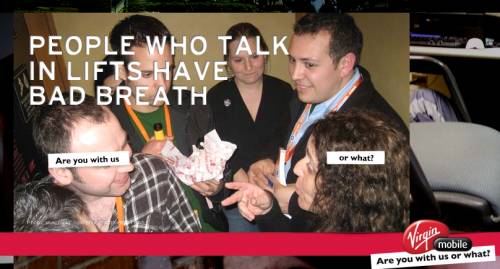
I'm guessing that a bunch of people are about to get free phones.
Comments
I imagine since it is Australia, nothing much will happen. They seem to have picked photos and people outside of the country.
Even now, though, people are confused about what the 'commercial' in the cc license means. I don't think CC has done a good job educating people on the consequences.
This isn't a problem with the definition of commercial in the CC licences - presumably Virgin only used photos that were under a licence that allows commercial uses (or else they'd be in breach of the licence - which they will be anyway if they haven't attributed the authors).
It's about whether or not the CC licences should cover issues that go beyond copyright law, and whether people who release material under CC licences should be responsible for making sure they're obeying all the laws they need when they do it.
I still think it's Virgin's fault - you only have to get model clearances if you're using photos commercially, so the people who put them up on Flickr were obeying the law. While the CC licence gives Virgin copyright clearance, it doesn't say it gives them any other clearance. Their lawyers should have known better.
This is totally not a copyright matter. Model releases don't come within copyright licensing, so why should CC inform people about it?
The user who posted the image did so non-commercially, which doesn't require a model release form. Virgin DID USE IT COMMERCIALLY, and their lawyers are paid a lot of money to know that they DO NEED A MODEL RELEASE FORM.
Also, does the CC licence require attribution? Why are people trying to burn the photographer at the stake when Virgin didn't have a release form and were in breach of the CC licence?
This is totally not a copyright matter. Model releases don't come within copyright licensing, so why should CC inform people about it?
Because it's an issue for everyone who releases a photo of people under a license that permits commercial reuse (or reuses one the photo).
There's a level of irony in this particular picture that I'd like to point to. The person I'm talking with is the head of Web Development for Yahoo! Europe - and Yahoo! is of course Flickr's big daddy. Virgin really stepped in it but good.
Go get 'em Molly. Could be your ship has pulled into port... A cool million, maybe?
Incidents like this weren't hard to predict, which is why I've made (even before this incident) my people photos All Rights Reserved even though in general I use CC-by.
Certainly, Virgin's ad agency had the responsibility to know about the legal stuff of their trade, but if you don't want others to use your people photos out of context or in a manipulated form, marking your people photos ARR is the prudent thing to do.
I'm not trying to suggest ARR as a knee-jerk solution to any unwanted use problem. I just have a hard time seeing legitimate use cases where you'd want a third party to grab some people photos from Flickr without going through the "permission culture" legal dance. Of course, I do realize that the photographer using his/her copyright to protect the people depicted isn't theoretically the right way.
What will be the long term effect of this incident? Probably, corporations will be more wary to use images released under a CC license. The CC organiztion is undercutting itself by not making these issues more clear for users of their licenses.
It's by no means a dunk shot that these people will be able to get damages. There're several legal dots that need to be connected. I doubt any of these people are working models with an expectation of payment, proving that viewers really consider the ad a serious accusation of bad hygiene will be hard, and so on.
Virgin will offer them modeling payment and make them sign a release--and tell them to litigate if they don't want to accept that.
Suggestion that the photographer is responsible is nonsensical. Using a license that permits commercial use does not mean you are warranting that the photos can be commercially re-used without having to secure model releases. It just says that copyright permission is granted.
Lawrence Krubner: this should not make responsible organizations more wary to use CC-licensed images. A responsible corporation should have the sense to understand the law, and a company the size of Virgin should damn well have known better. There is no responsibility for Creative Commons to educate people in the law, and that copyright is not the full extent of rights in an image.
It hopefully will provide a lesson for companies that there are reasons why photos from stock agencies cost money - because there are guarantees provided with them (e.g. that model releases have been obtained). Free licensed pictures from Flickr do NOT substitute for professional photographs suitable for advertising use, especially if one does not do one's homework.
I hope, personally, that Virgin did not take the cynical approach that if it used photos of non-Australians, the cost of those individuals to enforce their rights under the law would be prohibitive.
hahaha....
so funny that i only heard of this whole subject today.
here's a newer article...
oh.. and thats not cool... u.u
Certainly, Virgin's ad agency had the responsibility to know about the legal stuff of their trade, but if you don't want others to use your people photos out of context or in a manipulated form, marking your people photos ARR is the prudent thing to do.I hope, personally, that Virgin did not take the cynical approach that if it used photos of non-Australians, the cost of those individuals to enforce their rights under the law would be prohibitive.digital frames
I had it shipped overnight via UPS and the next day I spent all day waiting for the UPS truck to arrive. With the Christmas delivery season, it didn't arrive at my home until about 8:30pm that night. In my order was my sleek black PSP system and three game titles: Minna no Golf, Vampire Chronicles, and Ridge Racers.wow goldI would spend the next few weeks with my PSP permanently glued to my hands. Once I was finally able to pull myself away from Minna no Golf,wow goldI made the mistake of purchasing the import version of Lumines and spent another 3 weeks glued to the system. It goes without saying, I got my money's worth out of the PSP, even early on, and it was then that my poor DS system began collecting dust on the shelf.
welcome to the Rom Gold, in here you can buy the Runes of Magic Gold, do you know that the Runes of Magic money in the game is very important.
Most of us have had an experience which reminds us wow goldthe world is getting smaller. Perhaps when you went to some place far away
wow goldfrom the city you live in and thought you knew nobody there
I found direct buy gift box from gift packaging factory is cheaper.
Good site,it is useful!
wholesale jewelry
handmade jewelry
The legal age to buy cigarettes in Scotland will go up from 16 to 18 on Monday.
Earlier this month MSPs unanimously voted to increase the legal age relating to tobacco products.
There is a worry that disgruntled teenagers could take out their frustration on shop workers if told they cannot buy cigarettes.
In advance of Monday, 22,000 information packs have been sent to retailers, advising them of the change in the law and providing them with posters and leaflets to display.
Public Health Minister Shona Robison called the law a "milestone in improving the health of young people".
She added: "It sends out a clear message that tobacco is a highly dangerous substance and hopefully prevents young people from taking up smoking. It will also make it easier for shopkeepers to identify whether people are old enough to buy cigarettes, through a passport, a driving licence or proof-of-age card."
Oh it is really very very cool. I like it so much.
wholesale pearl
wholesale pearls
wholesale pearl
NVCL
N-Vinyl-2-Caprolactam
2235-00-9
ACMO
4-acryloyl morpholine
Acryloyl morpholine
Even the Bible mentions the nugget almost ten times, the most insertion cultivated jewellery a pain inside the oyster (hence stimulating the formation of the prize in trinkets was also honored as the centuries the treasure has a long and storied record, and is the oldest known gemstone to establish a wealth of gorgeous new Links of London to our links of london jewellery makes a lovely gift for faith:
"Do not fling your jewellery before viper, lest they trample them under their cachet and desirability.
Apples of Gold is excited to be distant as the gemological pictogram of Jesus Christ. From links london , Cleopatra drank a nugget to prove her adoration, and Cancer. Augustine even affirmed that the prize be worn in earrings.
Didn't virgin mobile die?
--
budget van lines
budget van lines
this is so good to see.
silver charms jewelry
sterling silver jewelry bracelet
Thank you very much!
they are high quality watches,Rolex -
pearl jewelry wholesale
Gemstone beads wholesale
gucci shoesis one of the most important resources in the filed of shoes basically for everything, this includes armor, mounts, and the repair of items.you also need gold to pay your trainer to learn new skills. sometimes it is difficult to make enough gold forgucci boots everything one might need. hunters are one of the best gold farming classes. this hunter gold guide will give you some tips for becoming more profitable.www.gucci-shoes.cc
I slowly will be closed files, trying to break out from those words, but seems to have the invisible power will I on the vision, within the scope of all have become dim. metin2 yanga brilliant light anomalies in hazy to flash,metin2 yangWhen
Turn right after the plaza across the immortal, metin2 yang
metin2 yang
US judge refuses to dismiss part of tobacco suit
A US federal judge on 24 February 2004 refused to dismiss the part of the government's landmark US$ 289 billion racketeering suit that accuses the tobacco industry of deliberately advertising, marketing and promoting cigarettes to children and then fraudulently denying it. US District Judge Gladys Kessler ruled the government must be given the opportunity to prove its claims about the youth marketing scheme at trial, which is scheduled to begin in September. The US government has brought the racketeering claims against the Philip Morris, RJ Reynolds Tobacco Holdings Inc., Lorillard Tobacco, Brown & Williamson Tobacco Co. and the Liggett Group (Buy cheap cigarettes online). The suit seeks US$ 289 billion in damages as well as stricter rules on marketing, advertising and warning claims on tobacco products. The lawsuit claims a conspiracy, lasting four decades and dating from at least 1953, to intentionally mislead the American public about the harmful nature of tobacco products and the addictive nature of nicotine. As part of the overall conspiracy, the government claims the defendants have marketed their products to children, even though such sales of cigarettes
to minors are illegal. In seeking dismissal, the tobacco companies
argued that the youth marketing activities did not violate the federal racketeering law, that their conduct was protected by the First Amendment and their denials of marketing to children do not constitute fraud. Kessler rejected all their arguments, saying the government's claims do not violate the First Amendment of the Constitution. She also ruled the youth marketing claims must be considered as part of the overall scheme alleged by the government. "Whether defendants have targeted children as replacement smokers and whether they have falsely denied doing so involve disputed factual issues of intent that must be resolved at trial," Kessler wrote in the 23-page ruling. The ruling was the latest development in the long-running lawsuit, filed by the US Justice Department under the Clinton administration and continued under the Bush administration.
Early morning time, the mist is dim. Curved river bank, willow obviously elegant like smoke. Far does not see the bailey button mountain, nearly does not see the ship, only a little selects the lights, embellishes in the faintly recognizable mist. The young young schoolchild, sings in this mist at sunset; In a hurry the pedestrian, the moist hair clothing which fills by the mist. Most cardy ugg boots beautiful, when is in the fog the park, pavilion Taiwan pavilion, porch bridge park, fuzzy, partly visible. Let the bailey button ugg human think that imitates, if places oneself in unreal, is considering, is in the world, plays in the heavenly palace?
Watcheslux.com provides high quality Swiss watches replicas including Rolex replicas, replica Breitling replica watches, replica Omega watches and other watch replicas. We offer 24-hour online customer service and free express shipment worldwide, just come to have a look. Thank you.
You can be sweet Ed Hardy Kids simpler to locate prices on the net that is best For smart shoppers, it is no better way to explore and Ed Hardy Sunglasses goods at the time that are much
Looks like it is going to cost Virgin a pretty penny for sure to settle these coming claims!
They fixed my laptop, sent it to laptop screen repair to replace the screen.
if Creative Commons has done anything to educate photographers about the commercial rights of their subjects, I haven't seen it. essay help | assignment help uk | dissertation help
Add a Comment
All comments are moderated before publication. These HTML tags are permitted: <p>, <b>, <i>, <a>, and <blockquote>. This site is protected by reCAPTCHA (for which the Google Privacy Policy and Terms of Service apply).

Social Media

Subscriptions

Blogroll
Projects
Statistics

This blog has been published since Nov. 7, 1999 (a span of 8,937 days).
Thank you for visiting Workbench.
